
What Do We Really Know About the Runes? Looking at the Rune Poems
When we read modern books on rune lore it can be easy to imagine there is a direct line of wisdom from our ancestors using the runes, right though to these well written and often fascinating books.
The truth is we have no surviving contemporary source that gives us the names, sounds, and meanings of all 24 runes of the Elder Futhark. Scholars, and sometimes authors, that want to solve the riddle of the runes, have created a 'best fit' working model for the Elder Futhark based on information we have for the 16 runes of the Younger Futhark.
This has lead to a mindset of unquestioning belief, and a lack of discussion or speculation, because many people have lost sight of what is core material, and what is a working 'best fit' model.
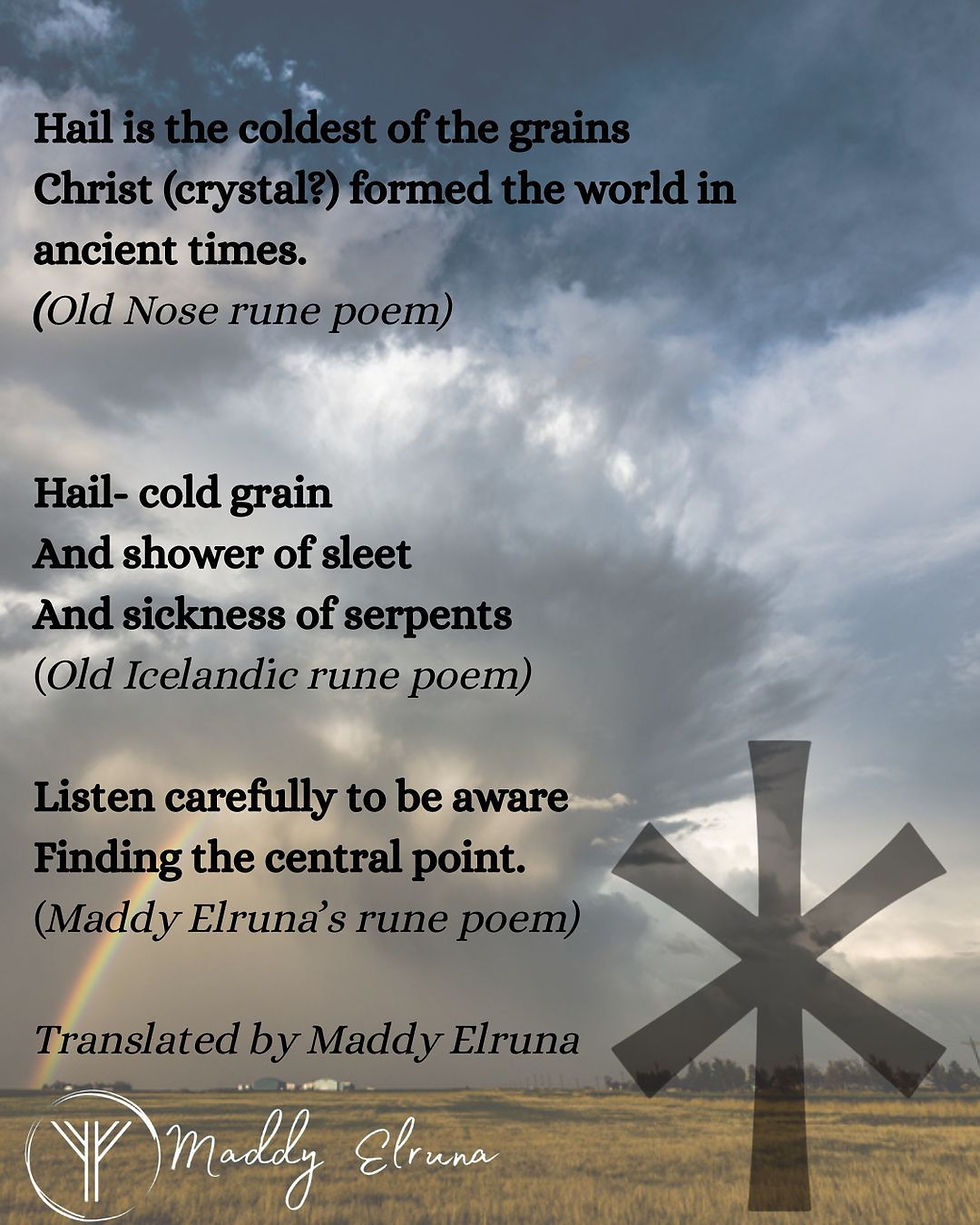
And even when it comes to my favourite resource for rune-lore, the Norwegian and Icelandic rune poems- there is still a lot of debate.
Firstly, whenever you are reading someone's translation- you are placing a lot of trust in their imterpretation. Part of the Old Icelandic rune poem for fe is; "Fé er frænda róg ok flæðar viti ok grafseiðs gata"
Now most people, and I have decided to follow tradition with my translations, whilst raising it as a discussion point, translate ok grafseiðs gata as 'and path of the serpent'. But this is not a direct translation, rather an added meaning to the words.
ok - is and
graf- can be mound, burial mound, or grave
seiðs- linked to witchcraft and sorcery, or possibly thread.
gata- gate, path, and possibly riddle.
For me when I think of this I reflect on how Freya, Frey's twin taught Odin seidr. And I connect it with the peace of Frodi (connected with Frey) and holding meetings on a successful Kings burial mound to bring in his luck, spiritual guidance, or 'hamingja'
Because the real meaning of the rune poems, or kennings (riddles ) is lost to us. It is up to each one of us to question all sources, all translations, read the myths, and find the rune meanings that work for us.
If you are looking for authentic sources for the rune sounds, names, and meanings there are a handful.
But even here, it is important to understand exactly what those sources are, and what they are not.
The Abecedarium Nordmannicum
The earliest surviving written list of the sixteen Younger Futhark runes is the Abecedarium Nordmannicum, dating from the 9th century.
It is found in the Codex Sangallensis 878, a manuscript held at the Abbey Library of St Gallen in Switzerland. It isn't a book about runes, or even a standalone rune poem. The rune names appear as part of a much larger collection of linguistic and religious material.
The Abecedarium is very short. Rather than giving a description of each rune, it gives the rune names in sequence in a few lines of verse. This makes it particularly valuable because it gives us an early written record of the names of the sixteen Younger Futhark runes.
There is also a rather unfortunate story attached to it. The original page was destroyed in the 19th century during an attempt to preserve it using chemicals. Fortunately, Wilhelm Grimm had made a drawing of the page in 1828, so the text itself was not completely lost.
The Old Norwegian Rune Poem
The Old Norwegian Rune Poem is probably from the 13th century. Unlike the very brief Abecedarium, this is a proper piece of poetry, describing all sixteen Younger Futhark runes.
Each rune is given a short two-line verse. The first line names or describes the rune, and the second develops the image or idea, often in a terse and almost proverb-like way. It is written in a form of skaldic verse, with alliteration and rhyme.
The original medieval manuscript has not survived. What we have comes from later copies, mainly from the 17th century, including a version published by the Danish scholar Ole Worm in 1636.
It is an incredibly useful source, but it is still a medieval poem rather than a dictionary of rune meanings. The poet was using imagery and wordplay, and some of that imagery is not straightforward for us to interpret today.
(And I have to admit- it is my favourite of the rune poems!)
The Old Icelandic Rune Poem
The Old Icelandic Rune Poem is later still. The poem survives in several Icelandic manuscripts, the earliest dating from the late 15th century, although the material itself may be older.
It also deals with the sixteen Younger Futhark runes, but its style is different again. Each rune is described through three short, poetic phrases or kennings. A kenning is a deliberately indirect way of referring to something - rather like a riddle or poetic description rather than a simple definition.
The Icelandic poem is therefore particularly interesting, because the words can be compact, ambiguous and open to interpretation.
This is one reason I am cautious when people present a single translation of a rune poem as though it gives us the definitive meaning of a rune. Even with a genuine historical source in front of us, we still have to interpret the language, the poetry, the cultural references. And we often can't be certain that changes weren't made as they were copied.
The Old English Rune Poem
There is one other rune poem worth knowing about, although it belongs to a different runic tradition. The Old English Rune Poem concerns the Anglo-Saxon Futhorc, not the sixteen-rune Younger Futhark. By this period the Anglo-Saxon rune row had expanded to 29 runes.
The poem is much more developed than the Norwegian or Icelandic poems. Each of the 29 runes has its own short stanza, with considerably more description, imagery and poetic development. This is why it is so often used in modern rune books as a source for rune meanings, even though it comes from a different alphabet and a different cultural tradition.
The original manuscript, Cotton Otho B.x, was destroyed in the Ashburnham House fire of 1731. Thankfully, the poem had already been transcribed by Humfrey Wanley, and that transcription was published by George Hickes in 1705.
So although the Old English Rune Poem is a genuine and extremely valuable historical source, it should not be confused with evidence for the meanings of the Elder or Younger Futhark runes. It can provide fascinating comparisons, but it belongs to its own tradition.
As part of my runelore training I translated the Old Norse, and Old Icelandic poems. It was utterly fascinating to appreciate how much power the translator has. Now, nearly 30 years later I have created my own rune poems to reflect the wisdom- as I expereince it- in each rune.